


UX Research Study by Elizabeth Turnell
Executive Summary
Austin Center for Design, founded in 2009, recognized that as the industry shifts, their programs must evolve too. To understand what modern designers actually need, they invited me to gather insights directly from students and working practitioners.
Over the past month, I interviewed six designers across career stages to uncover barriers to design education and clarify their learning goals.
What surfaced is clear: AI is reshaping how designers think, learn, and work, and current learning models aren’t keeping up. Designers highlighted exactly where traditional education falls short and what AC4D must update to prepare them for an AI-driven practice. Design is shifting rapidly, but our educational systems haven’t shifted with it.
The Moment We Are In
Before this study, I was stuck in a Schrödinger’s-cat moment with AI: both ignoring its presence in my work and knowing it was quietly shaping everything around me.
What I found from this study is simple: designers aren’t just creating anymore; they’re directing, critiquing, and negotiating with AI as part of their daily workflow.
So What’s the Problem Here?
Companies are introducing AI tools far faster than they’re creating guardrails for using them.
- Policies are unclear or missing entirely, leaving teams to guess what’s acceptable.
- Due to that, designers are effectively handed powerful AI systems without rules, boundaries, or a shared definition of “responsible use,” forcing them to improvise ethics on the fly.
At the same time, design education is still teaching tools more than thinking.
- Learners can execute tasks, but they struggle to evaluate their own work or reason about systems.
- They understand the tools, but not the larger systems their design decisions affect.
In short: Designers are relying on AI without real guidance, pushed to set their own ethical limits while design programs continue to emphasize software proficiency over the systems-level thinking needed to use AI responsibly.
One Shared Reality
I spoke with designers at various career stages who identified as current or former non-traditional design learners, and a clear theme emerged from their reflections on study habits and workflows: AI isn’t just accelerating their work; it’s redefining what work means altogether.
The Hard Truths Emerging From This Study
- Designers now trust AI more than each other, and it’s eroding the collaborative thinking that defines good design.
AI is stepping into roles teammates once filled, reshaping how designers work and solve problems.
With AI handling the groundwork instantly, the collaborative back-and-forth that builds critical thinking, creative confidence, and team connection quietly disappears.
AI is now the fastest way to stay current, sharpen ideas, and keep pace with rising expectations, removing the need to wait for feedback, brainstorm with peers, or sketch early concepts together.
In short: AI’s speed and convenience are replacing the collaboration that strengthens design thinking, leaving designers relying on AI more than each other.
2. AI’s expanding role is exposing two key gaps: designers are guessing their way through ethical use with no clear guidance, and the lack of technical fluency only makes those decisions harder and riskier.
- Designers experience ethical dilemmas with how to integrate AI into their workflow, challenging designers to think more critically about ethics and bias, ensuring human judgment still drives decisions.
- They’ve realized that Gen-AI design literacy is now just as essential as traditional design skills. As workflows become faster and more automated, the designer’s edge lies in framing the right prompts, setting constraints, and interpreting outcomes.
In short: Designers are operating in an AI landscape with no rulebook, forcing them to make ethical calls without guidance while also trying to build the technical fluency needed to use AI responsibly and effectively.
3. Self-paced learning falls short because designers can’t reliably judge the quality of their own work without guided feedback.
Without critique, designers plateau. Without mentorship, they repeat the same mistakes.
- Independent design learners consistently reported that self-paced learning helps them pick up tools quickly, but leaves them without a way to judge the quality of their work.
- What they value in formal education isn’t instruction alone, it’s the structured critique, mentorship, and collaborative practice that self-paced environments lack.
In short: Self-paced learning teaches tools, but without critique or mentorship, designers can’t judge their own work, fix their blind spots, or grow beyond the limits of their solo practice.
4. Design education has a blind spot: It doesn’t teach the workflow skills employers actually hire for.
Designers made it clear that employers hire for the ability to build scalable systems and work within real production workflows, yet those skills are rarely taught.
- Self-taught learners admitted they often skip core design phases, creating gaps in how they understand and solve real-world problems.
- Many struggled to translate their skills into production-ready workflows because they were never taught how to operate in those environments.
In short: When self-taught learners bypass foundational design learning, they miss the systems, structure, and workflow discipline that employers actually hire for.
5. Critical thinking is now the only safeguard against being replaced by AI-driven execution.
As the AI hype cycle accelerates and absorbs more executional work, designers increasingly see that their value comes from what AI can’t replicate.
- AI can’t replicate interpreting nuance, weighing tradeoffs, and anticipating system-level consequences.
- They recognize that razor-sharp critical thinking, not technical skill alone, will determine who remains competitive in the future of the design industry.
In short: As AI takes over execution, designers’ real value comes down to sharp critical thinking—the one skill AI can’t replace and the one that will determine who stays competitive.
So What Should Design Education Teach Now?
As more design students aim to position themselves for real job opportunities, design education cannot be centered around self-instructed learning. Students want skills that translate directly into employment.
These four strategic shifts give recent graduates exactly that. They prepare students to enter the field with confidence, navigate the growing influence of AI, and understand why independent thought is becoming a non-negotiable skill.
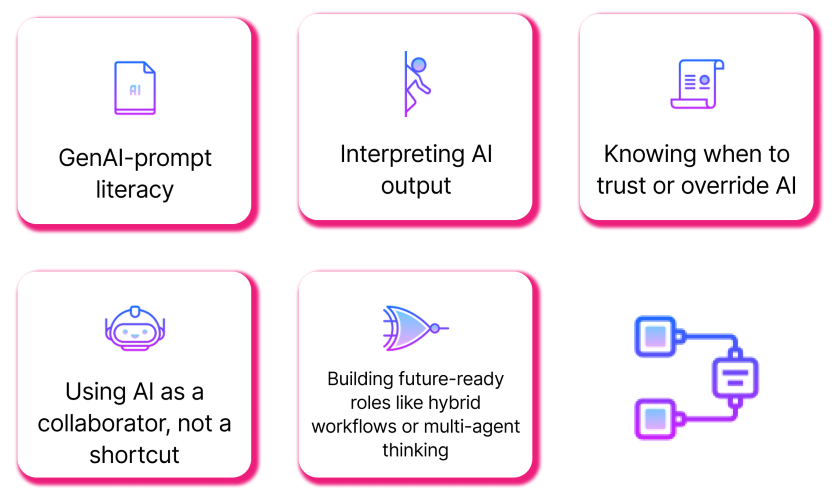
Shift 1: From Teaching Product Tools to Teaching Collaboration With AI
Focus: The relationship between designers and AI.
Goal: Teach students how to think with AI, direct it, critique it, and understand its limits.
Core Problem It Solves:Designers are already using AI, but without understanding how to evaluate what AI produces.
In Short: Teach designers how to think and collaborate with AI, and develop the literacy, judgment, and ethical awareness needed to guide intelligent systems responsibly.
Shift 1 Focuses On:
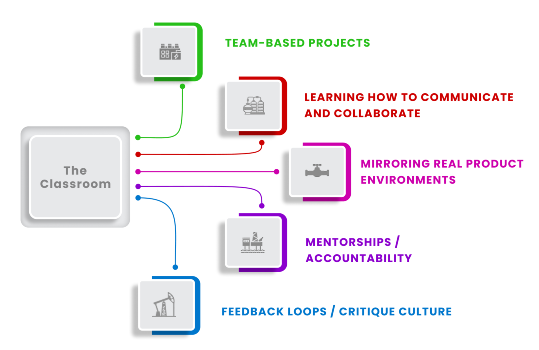
Shift 2: From Independent Study to Collaborative, Team-Based Design
Focus: The relationship between students and people without the collaboration of AI.
Goal: Replace isolated, self-paced learning with professional-grade collaboration, critique, and teamwork.
Core Problem It Solves: Learners know the tools but lack the ability to work like actual designers in real organizations.
In short: Elevate how designers work with teams and navigate real-world processes.
Shift 2 Focuses on:
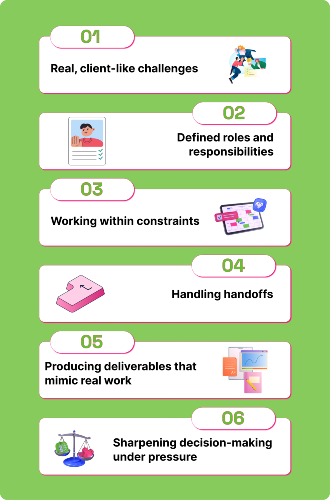
Shift 3: From Classroom Exercises to Simulated Product Teams
Focus: Preparing students to operate inside real product environments.
Goal: Give students exposure to the realities of working on actual teams with actual constraints, not hypothetical classroom scenarios.
Core Problem It Solves: Learners cannot navigate real-world complexity, and lack the soft skills that can be found in a strong resume.
In short: Preparing students to work within real production environments will help them learn how to navigate the workplace effectively.
Shift 3 Focuses On:
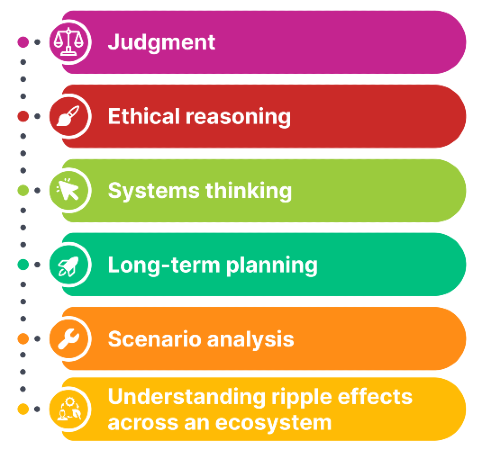
Strategic Shift 4: From Task Execution to Strategic Decision-Making
Focus: Developing designers who can think beyond the interface and reason across systems, consequences, and long-term impact.
Goal: Build designers who can analyze tradeoffs, understand system dynamics, evaluate ethical implications, and make decisions that shape product direction—not just produce outputs.
Core Problem It Solves: Many learners can execute tasks, but they struggle to think strategically about complexity, impact, and interconnected systems.
In Short: This shift strengthens how designers think, equipping them to lead with strategic insight rather than operate purely as executors.
What AI Cannot Automate:
Conclusion
Designers are learning fast, but without structure, guidance, or systems-level understanding, many are advancing blindly. This moment calls for a decisive shift: design education must move beyond teaching tools and techniques to cultivating critical thinkers who can collaborate with AI, navigate complexity, and lead with strategy and ethics.
So What Happens Now?
Now that we understand what it will take to prepare the designers of the future, the next question is how will education rise to meet that challenge? How will schools teach AI as more than a tool, and help designers rethink what design itself means?
While this study reflects insights from a small group of designers, I invite others to share how they’re learning, teaching, or integrating AI into their workflows. I’m especially eager to hear from design programs that are rethinking their curriculum to prepare students for an AI-driven world.

